MY BLOG
For over three decades, Andrew von Dadelszen has shared candid, thoughtful analysis on the issues shaping our world. Explore recent writings covering political dynamics, long-term investment strategies, and global developments.
Health Targets: Results Matter More Than Rhetoric
Despite Focus groups saying Labour is better at Health than National, the evidence demonstrated the opposite.
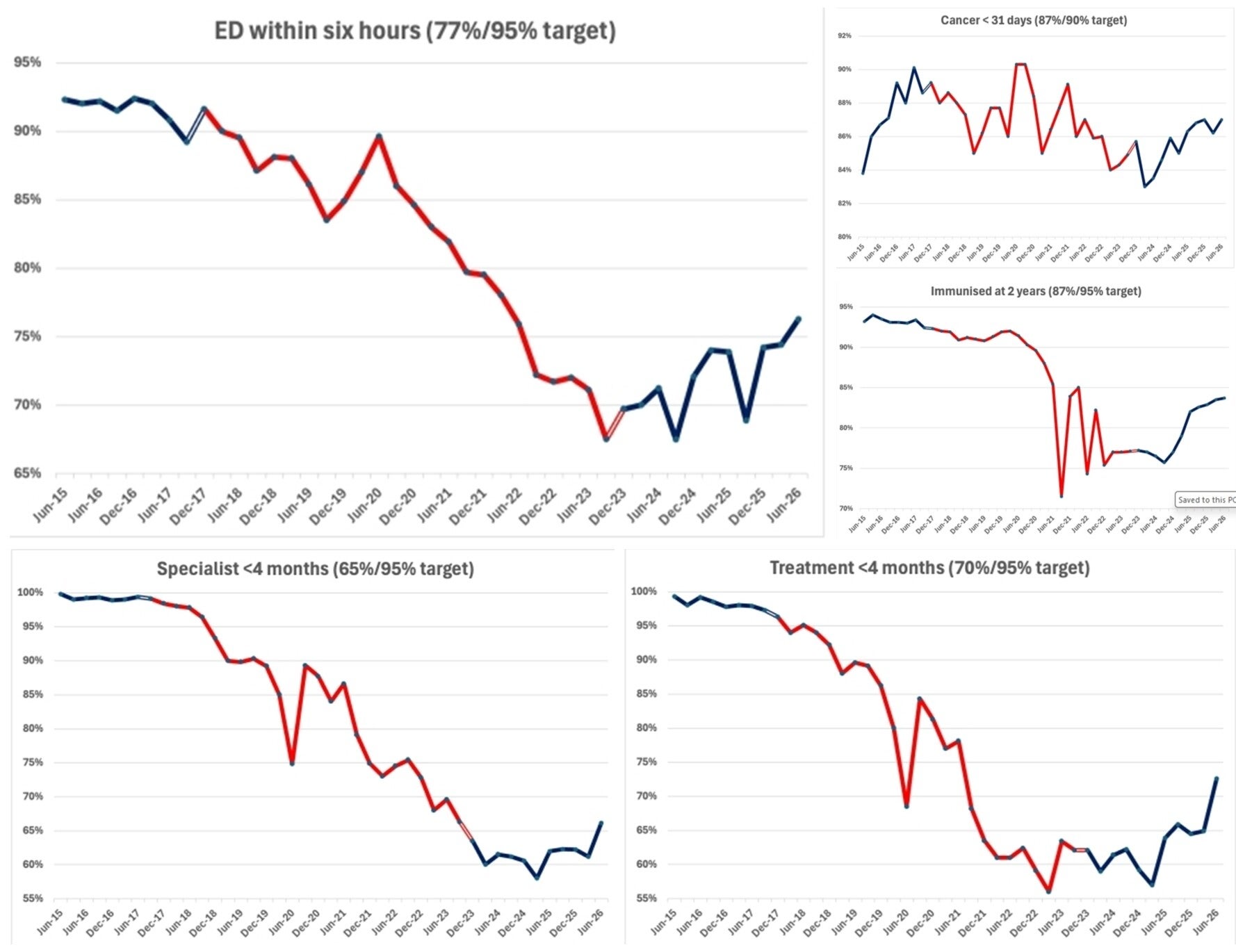
David Farrar's analysis on Kiwiblog highlights an encouraging turnaround in New Zealand's public health system. After years of deteriorating performance, all five of the Government's key health targets are moving in the right direction.
The previous Labour Government abolished almost all the health targets, did a distastrous mega-merger during a pandemic, and outcomes in the health sector fell across the board. The health sector is still under great strain, but the data shows that there has been considerable improvement in all five target areas. This is the latest data to June 2026.
The figures are significant: cancer treatment timeliness has improved to 87%, childhood immunisation has climbed to 84%, emergency department performance has recovered to 76%, and specialist assessments and elective treatment are becoming more timely. This is around 11,000 more patients who got elective surgery in the last year within four months.
Behind these percentages are real people: thousands more children vaccinated, cancer patients treated sooner, and tens of thousands of New Zealanders receiving faster hospital care.
The health system remains under considerable pressure, and none of these improvements justifies complacency. But progress deserves recognition.
Clear targets, transparent measurement and accountability are essential to improving public services. They focus attention on outcomes rather than bureaucratic restructuring or political announcements.
The lesson is straightforward: governments should be judged not by how much they spend or how often they reorganise departments, but by the results they deliver for New Zealanders.
The direction of travel is encouraging. The challenge now is to sustain it.
Labour's track record with Food Price Inflation is dire
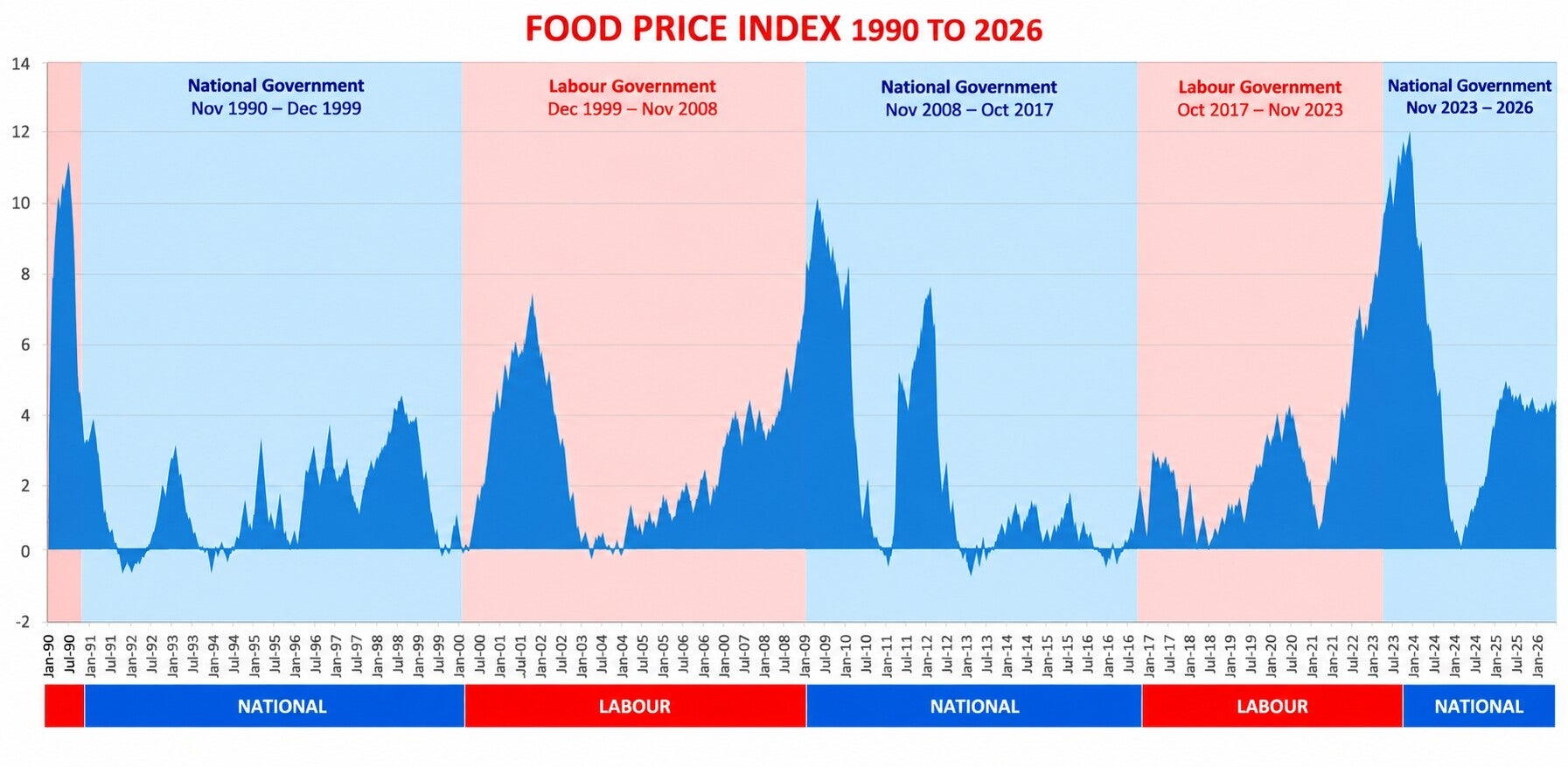
When we look at a graph of Food Price Inflation in New Zealand (since 1990) it is obvious that inflation (& Food Price Inflation in particular) is an "Achilles heel" for Labour.
With the "Cost of Living" foremost in voters mind, as we head towards the 7th November Election, it is essential that both Left and Right leaning voters do not put their livelihoods at risk.
Our current government is rebuilding this country's economic well-being, so don't put that at risk - Party Vote National.
And don't risk it all with the "strategic voting" being promoted by ACT. That is an extremely risky proposition for a strong Right Leaning Government.
Comparing GDP Growth in last 12 months to 30th June 2026
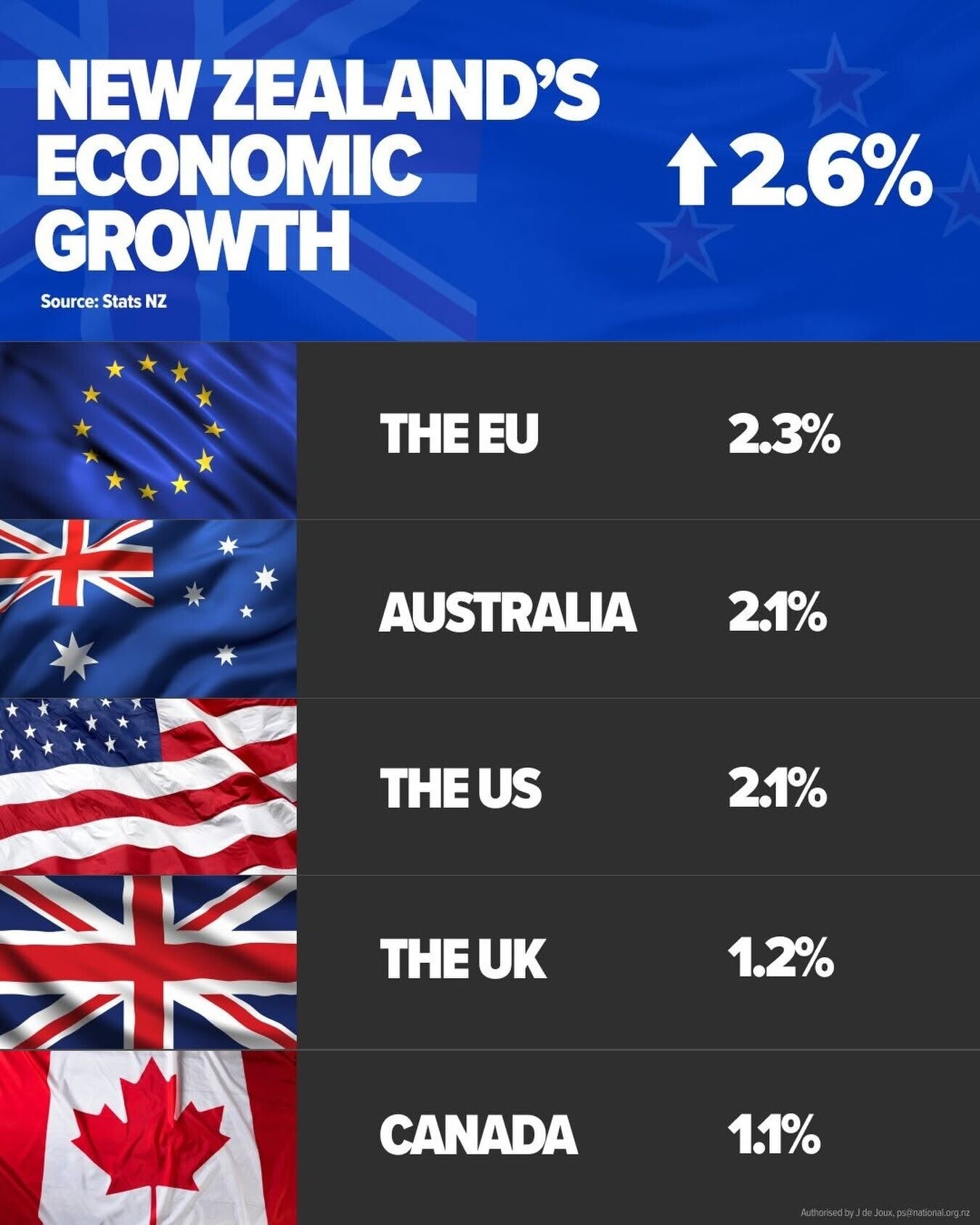
New Zealand grew more strongly than Western Economies (up 2.6%) over the 12-months to 30th June 2026. This has been a great result for all New Zealanders, in an extremely “trying” period of global unrest – including Trump’s tariff wars..
Expenditure GDP up 0.4%
The expenditure measure of GDP rose 0.4% in the June 2026 quarter, following a 1.1% increase in the March 2026 quarter.
The largest downward contributors to GDP in Q-Jun-26 were transport, postal, and warehousing (down 1.7%), and retail trade and accommodation (down 1.0%).
GDP per capita rose 0.1% during Q-Jun-26, 1.5% per year (only outperformed slightly by the US).
The comparison is rather more favourable to New Zealand than it has been for several years. After a prolonged period in which rapid population growth masked weakness in output per person, real GDP per capita is now growing again.
Australia provides the clearest contrast. Its headline GDP increased 2.1%, but GDP per person increased only 0.7%, because population growth absorbed roughly two-thirds of the aggregate economic expansion.
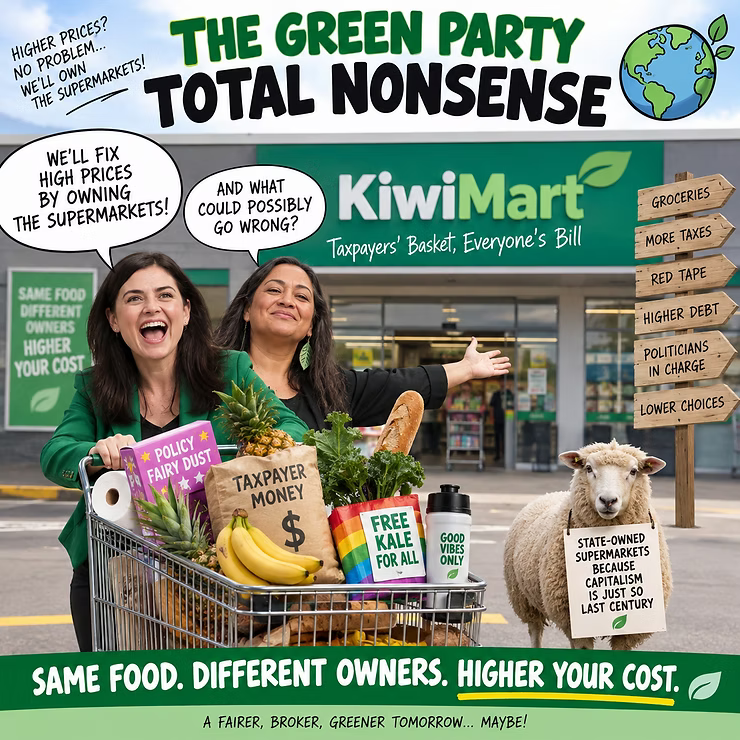
Green madness - KiwiMart is a NONSENSE
The Green Party has unveiled one of the most interventionist economic policies seen in New Zealand for decades—spending $2.8 billion to establish a government-owned supermarket chain called KiwiMart.
The Greens would force Woolworths and Foodstuffs owners to sell 120 supermarkets and two distribution centres to the Crown for an estimated $1.3 billion, before injecting another $1.5 billion of taxpayers' money into the new business.
There is no question New Zealand needs greater grocery competition. But nationalising supermarkets is a remarkably expensive way of trying to achieve it.
If KiwiMart can compete commercially with Woolworths and Foodstuffs, why does the taxpayer need to own it? If it cannot, taxpayers will ultimately subsidise its losses.
Government would also become supermarket owner, regulator and competition-policy maker simultaneously—creating an obvious potential conflict.
And KiwiMart is only part of the Greens' announcement. Their wider food package carries a gross four-year cost of around $6.2 billion, including $2.25 billion for expanding and changing the school lunch programme.
New Zealand doesn't need politicians running the supermarkets. This is plain socialist (communist) nonsense.